SpaceX — The S&P 500 Stands Tall While Nasdaq Accommodates
How the retail investor holding stock index funds is affected.
by Eric Roehm
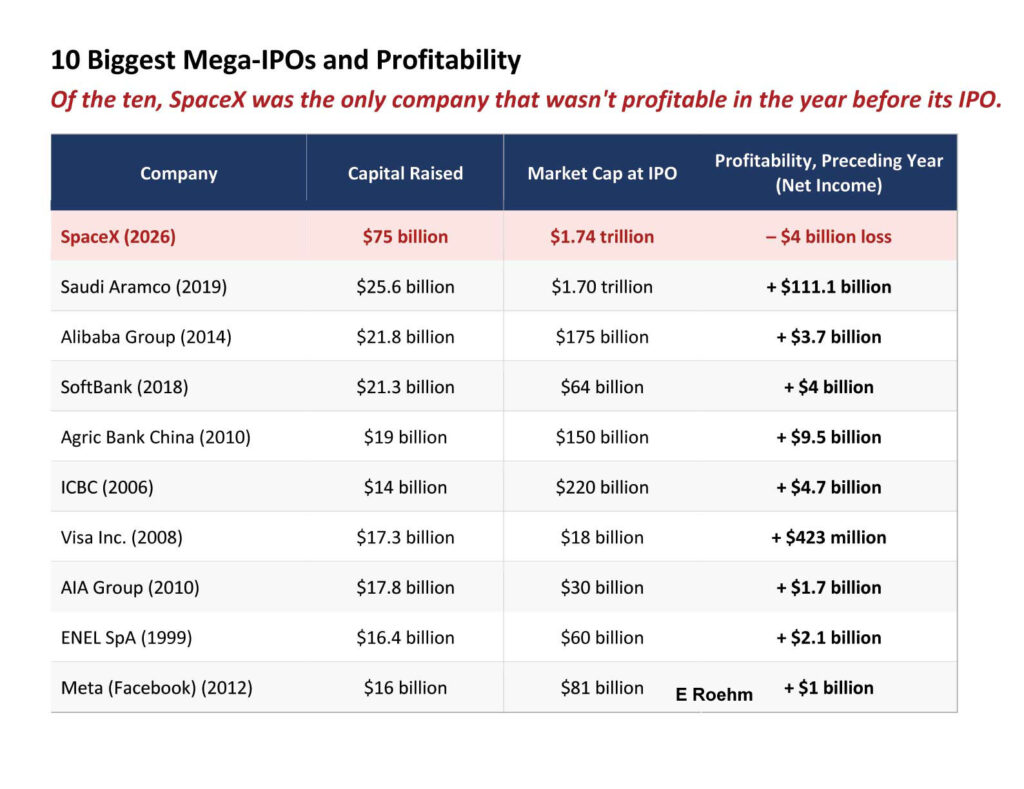
The SpaceX (SPCX) initial public offering is the story of one man using his company’s influence to reshape how his own IPO would be handled once it reached the market. The IPO raised more money than any IPO in history ($75 billion), carried the largest total market cap of any IPO ($1.74 trillion), and was the only top-10 IPO that wasn’t meaningfully profitable at the time of its listing — SpaceX, once all of its components are combined, lost more than $4 billion in the prior year.
What Musk Wanted
Elon Musk wanted index funds to include SpaceX far sooner than existing rules allowed, and he wanted to shorten the lockup period before early investors and employees could sell their shares. The length of that lockup was worked out between his IPO team and the underwriters. He also wanted underwriters to be comfortable with an unusual structure: the shares sold to the public carried none of the voting rights that normally come with ownership in a public company — those votes stayed with Musk. With the early inclusion in stock indices and a shortened lockup period for early investors, the market had less time to find SpaceX’s true value through ordinary buying and selling of shares. Several major indices (NASDQ 100 and Russell 1000) shortened the waiting period required before a mega-IPO would be added. Insider share sales were allowed to begin markedly earlier than usual, though released more gradually and on a more staggered schedule than is typical, in an apparent effort to avoid a sharp drop in the stock’s value.
Why This Matters to Retail Investors
These changes matter to everyday retail investors who already hold stock through index funds — the S&P 500, total-market funds such as Vanguard’s Total Stock Market ETF (VTI), the Nasdaq-100, and the Russell indices. Because of the timing change Musk pushed for, indices like the Nasdaq-100 ended up buying SpaceX stock before early investors and employees had sold any of their own shares.
How Index Funds Weight a New Stock
Of these indices, the total-market funds that follow CRSP (index rules managed by Morningstar) were already adding IPOs early — but only buying shares in proportion to the number of shares actually sold to the public, multiplied by the share price. This is known as the float market capitalization. Because SpaceX sold only a small fraction of its total shares (about 5%), only the value of that 5% factored into its weighting, which in turn determines how much stock the index needs to buy.
Nasdaq was the outlier among these indices. Its prior rules held that once a stock had 10% of its total shares available to the public, the full value of all outstanding shares — not just the float — counted toward its index weighting. That meant a stock with just 10% public ownership would be weighted ten times higher than under the other indices’ rules. (Nasdaq has since changed this: it now uses three times the float-adjusted market cap up to a 33% public float, after which it simply uses total market capitalization.)
The Nasdaq Deal
Musk had other concerns as well. He wanted SpaceX eligible for index inclusion much sooner after the IPO. Previously, Nasdaq required a minimum of 90 days between an IPO and inclusion in its index funds, and additions were typically made only once a year, in December — meaning the actual delay usually ran anywhere from three to twelve months. Musk had significant leverage here: he could choose where to list SpaceX, and the Nasdaq stock exchange stood to profit both from the listing itself and from the prestige of hosting it. The New York Stock Exchange, by contrast, had no vehicle capable of replicating the scale of the Nasdaq-100’s automatic, forced-buying mechanism. Nasdaq changed its rules, and SpaceX now trades there.
Fifteen Trading Days
The result: SpaceX was added to the Nasdaq-100 just 15 trading days after the IPO, at three times its market float — which meant funds tracking the index began buying almost immediately, well before insiders and employees had sold any shares. The usual give-and-take between buyers and sellers that normally helps a stock settle on a fair price had far less time to play out. As a result, retail investors in Nasdaq-100 funds bought SpaceX at prices that didn’t yet reflect the downward pressure to come — whether from early investors and employees actually selling their shares, or from the market beginning to anticipate that future selling in advance.
What Did the S&P 500 Decide?
It kept its rules unchanged. To join the S&P 500, a company must be at least 12 months past its IPO, profitable in the quarter before inclusion, and profitable across the trailing four quarters combined. Worth noting: the committee that runs the S&P 500 doesn’t own a stock exchange.
Why That Matters
Because the amount of money tracking the S&P 500 is enormous — roughly $30 trillion. By comparison, assets tracking the Nasdaq-100 total somewhere between $600 and $800 billion.
The Dollar Amounts
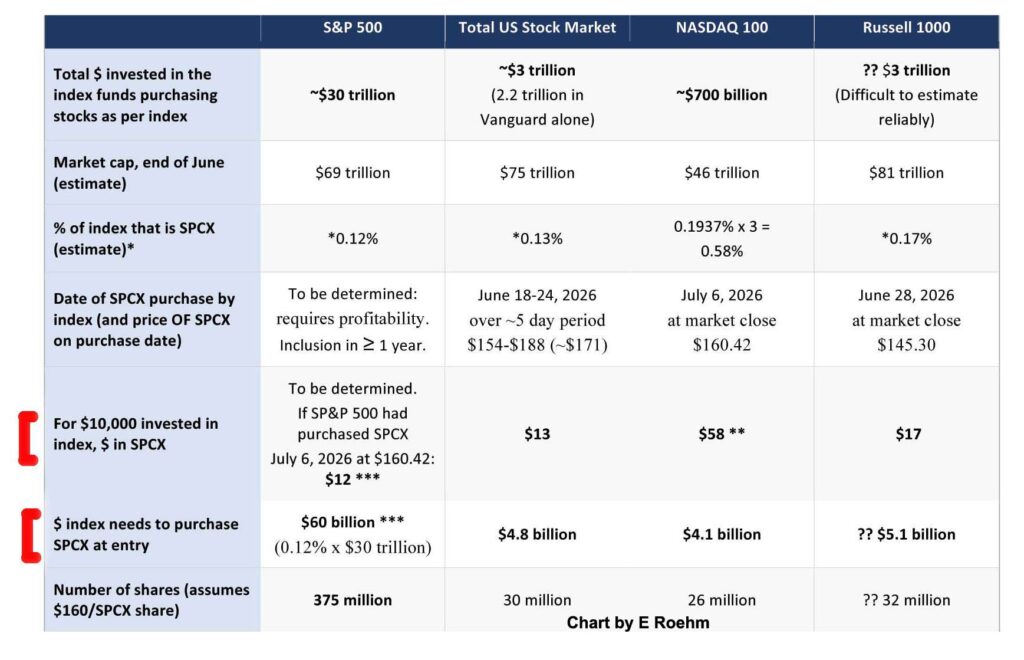
Even though Nasdaq values SpaceX at three times its float (shares available to the public × share price × 3), while the S&P 500 would simply use the market float, S&P 500 inclusion would still have meant a far larger dollar amount of SpaceX shares being purchased, simply because of the index’s size. Nasdaq indices have bought an estimated $4 billion of SpaceX stock. Had the S&P 500 listed SpaceX early, it would have bought at least $60 billion in SpaceX stock. (See chart.)
The chart also shows how much of a $10,000 investment in each index would end up in SpaceX stock. Had the S&P 500 added it early to the index, about $12 of every $10,000 invested would be in SpaceX. For the total U.S. stock market index, that figure is $13. For the Nasdaq-100, it’s $58 — reflecting the 3x factor Nasdaq applies when weighting SpaceX stock.
The Other Indices
As for the other indices: the total-market funds using CRSP rules — with roughly $3 trillion under management, including $2 trillion in Vanguard funds alone — left their methodology unchanged and added SpaceX five trading days after the IPO, at its market float value. The Russell indices changed their timing rules to allow earlier inclusion, but kept the same float-based weighting as the CRSP methodology.
The Bottom Line
In short, SpaceX is exactly the kind of IPO where it would have made sense to delay index inclusion until after insiders and employees had a chance to sell. It was the only one of the top ten mega-IPOs that wasn’t profitable at the time of its offering — with a $4.3 billion loss — which raises real questions about whether the share price can hold once insider sales pick up in volume. The S&P 500’s index committee kept its rules unchanged, which aligned with retail investors’ interests: rather than buy $60 billion worth of SpaceX shares at a questionable moment, its rules require a company to be seasoned and profitable first. That means far less retail investor money is at risk of propping up SpaceX’s share price while insiders sell. Hats off to the S&P 500.
Disclosure: The author bought SPCX stock at the IPO as a retail investor and has since sold that position at market open on July 7, 2026.