
AI Political Robocalls to Your Cell Phone? The FCC Wants to Hear from You by October 19th
Your chance to comment ends October 19.
The Federal Communications Commission is weighing a request that would allow political groups to place robocalls to Americans’ cell phones without first getting permission, including calls that use AI-generated voices. The public can weigh in, but the window is short.
How to submit your comment to FCC
Deadline: Monday, October 19, 2026. The FCC could make a decision soon after, possibly before the end of October.
FCC considers allowing AI political robocalls before midterms- AP news
What is being proposed
On August 31, the Club for Growth, a conservative economic policy group, filed a “Petition for Expedited Waiver” with the FCC. It asks the agency to let callers make political calls to cell phones using an artificial or prerecorded voice, including an AI-generated voice, without the called person’s prior express consent. The group says it wants the change in place for the November 3 midterm elections. According to Reuters, the Club for Growth plans to spend $175 million on this year’s congressional races.
Under current rules, robocalls to a cell phone that use an artificial or prerecorded voice generally require your consent. In 2024 the FCC ruled that AI-generated voices fall under that rule. That ruling came shortly after thousands of New Hampshire voters got a fake robocall in the voice of then-President Joe Biden telling them to skip the primary.
Home landlines are treated differently. Political and other noncommercial robocalls can go to a landline without consent, but only three calls in 30 days, and the caller must offer an automated way to opt out.
The arguments for and the response of those who think this is a very bad idea
The Club for Growth argues the current rules limit free speech and rules for consent are out of date. The group also says these are not really robocalls, because a person starts each call before an AI agent takes over the conversation. Its president, David McIntosh, said the FCC should treat political speech “the same way it already treats wireless calls about package deliveries, bank accounts, and doctor’s appointments.”
Critics see it very differently. Anna Gomez, the only Democrat among the FCC’s three sitting commissioners, told the Associated Press the change would create “a tsunami of robocalls and misinformation.” A coalition that includes the Consumer Federation of America, Common Cause, Public Citizen and the Leadership Conference on Civil and Human Rights has urged the FCC to reject the petition. Experts at the Brennan Center for Justice and the Center for Democracy and Technology warn that AI voice agents could mislead voters in live conversations, and that voters may not know how their answers are being recorded or used. They also note the timing, just weeks before an election, when a misleading call can do the most harm.
If the petition is approved, it would not apply only to the Club for Growth. Political groups of any party could use it.
How to send your comment to the FCC
Anyone can file a comment. It takes about five to ten minutes and is free.
- Go to the FCC’s Express Comment page: https://www.fcc.gov/ecfs/filings/express
- In Proceeding(s), type “02-278“, then click the line that immediately appears below it: “02-278 | Rules and Regulations Implementing the Telephone Consumer Protection Act of 1991“.
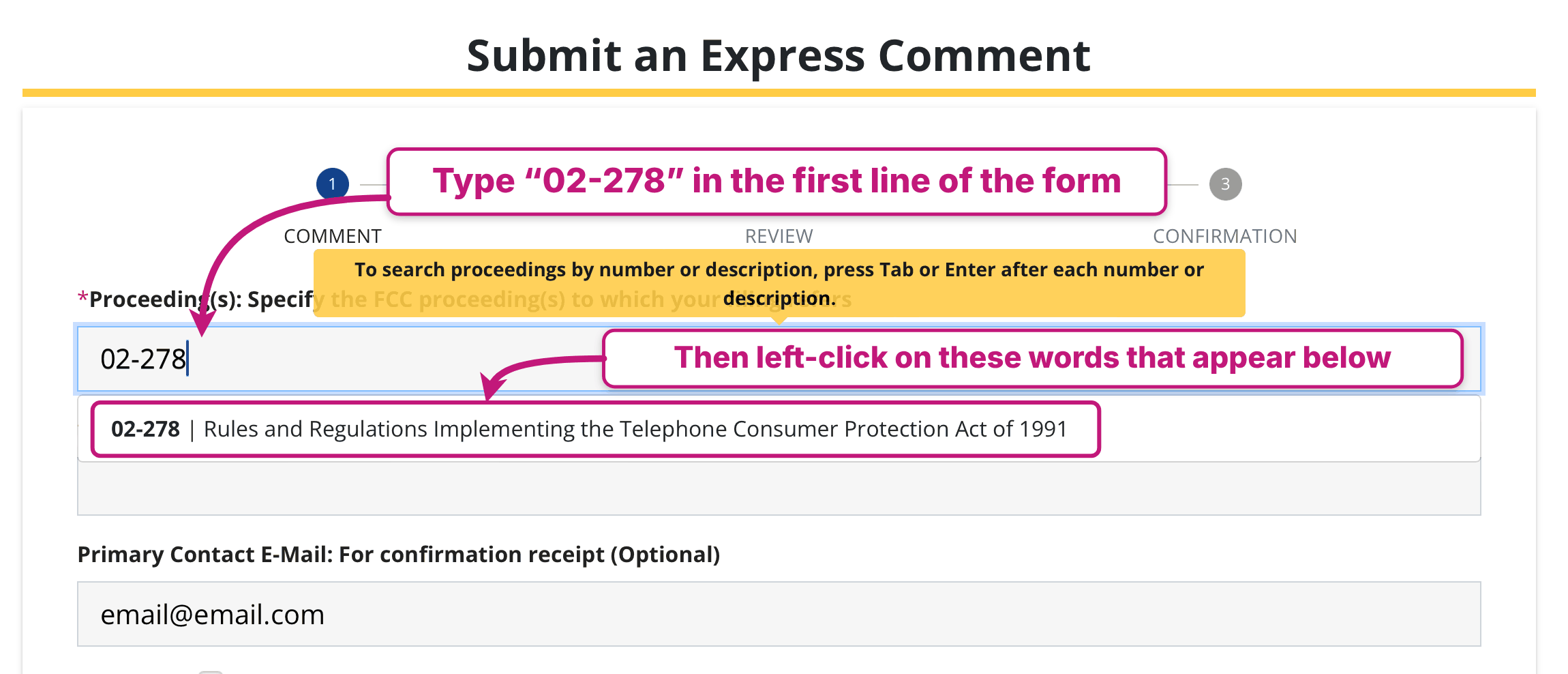
- In Name(s) of Filer(s), type your name and press Enter. (Your name will turn into a yellow tag.)
- Your email address is optional, but it gets you a confirmation receipt.
- Fill in your mailing address. It is required.
- Scroll down to the comment box and type or paste your comment. Docket 02-278 covers many robocall issues, so start with this line to make clear what you are writing about: Re: Petition for Expedited Waiver filed by Club for Growth. (See sample letters below.)
- Continue to the Review step, check your comment, and then submit it.
- Since technically the FCC is now asking for replies to comments, it is best to add a line, “I agree with the prior submissions to the FCC opposing this proposal.” if that is consistent with what you think about this issue. (See sample letters below.)
Comments are public, so don’t include anything in the comment box you would not want posted online. A comment in your own words, even a sentence or two about your own experience with robocalls, carries more weight than an identical form letter. Feel free to use the sample letters below as a starting point and change them as you like.
Sample letters
Sample letter to FCC #1 – Short and Personal – Make your own personal comments to be more effective
Re: Club for Growth Petition for Expedited Waiver
To the FCC:
I am against the Club for Growth’s proposal to change the rules and allow political robocalls to mobile phones without consent. Their proposal to allow robocalls to cell phones using AI voices or chatbots is an even worse idea. I agree with the other submissions to the FCC opposing this proposal.
[Your name]
Sample letter to FCC #2 Shortcomings of the Club for Growth’s Arguments for Making This Change –Make your own personal comments to be more effective
Re: Club for Growth Petition for Expedited Waiver
To the FCC:
I am writing as an individual to oppose the Club for Growth’s request to allow political robocalls to our cell phones without our prior express consent, including calls that use an artificial voice such as an AI-generated voice or an AI chatbot. I agree with the comments filed by the Consumer Federation of America, Public Citizen and others opposing this petition.
The Club for Growth says these are not really robocalls because a person starts each call before an AI agent takes over the conversation. But if all that person does is click a button to initiate the call, one person can launch a huge number of calls in an hour. To the person receiving the call, that is a robocall.
Under current rules, robocalls to cell phones generally require consent. There are a few exceptions, including package delivery notices and reminders from a doctor’s office. The Club for Growth argues that political calls deserve the same treatment as these. There is a major difference. With a package delivery or a doctor’s appointment, the person receiving the call already started the relationship and reasonably expects to hear about it. Nobody signed up to receive an unsolicited political call from an AI voice.
The Club for Growth also argues that since political calls to home landlines can be made without consent, cell phones should follow the same rules for consistency. That ignores the real differences between a cell phone and a landline. A cell phone goes everywhere with us and is the most personal way to reach us. That is exactly why the current rules are different. If consistency is the goal, then political robocalls to landlines should also require consent. Also, the petition’s limit of three calls in 30 days applies to each caller. With dozens of campaigns and groups calling before an election, that could still mean a flood of calls, and opting out only stops one group at a time.
AI robocalls deserve careful and thorough review, not an expedited decision right before an election. AI-generated voices and chatbots keep getting more convincing, which makes them easier to misuse. And if an AI chatbot is having a live conversation with a voter, how will anyone reliably record or review what was said to check for misuse?
I strongly oppose the proposal to allow political robocalls to our cell phones without our prior express consent.
[Your name]
Sample letter to FCC #3 Too big a change for a rushed waiver
–Make your own personal comments to be more effectiveRe: Club for Growth Petition for Expedited Waiver
To the FCC:
Changing FCC rules to allow political robocalls to our cell phones without our consent, including robocalls that use AI-generated voices, is a very bad idea. I agree with the prior submissions to the FCC opposing this proposal.
Under current rules, a robocall to a cell phone using an artificial or prerecorded voice generally requires the person’s prior express consent. Political calls to home landlines are treated differently. They can be made without consent, but only up to three calls in 30 days and with an opt-out. In its petition, the Club for Growth argues that cell phones should follow the same rules as landlines for the sake of consistency. That ignores the fact that a cell phone is not like a landline. Most of us carry our cell phone with us all day, and it is the most personal way anyone can reach us. That is the very reason the rules for the two have always been different. If the FCC believes cell phones and landlines need to be treated the same, then it would be better to require consent for both types of phones rather than remove the current consent requirement for cell phones.
AI is improving very quickly. Robocalls using AI-generated voices or AI chatbots should not be allowed without consent. AI will be used to deceive people, and in a political call the damage can be done before anyone catches it. A change like this needs broad public input and careful study, not a rushed decision just weeks before an election.
Please deny the Club for Growth’s petition and keep the consent requirement for political robocalls to cell phones.
[Your name]
Sources:
FCC Public Notice DA 26-940
Club for Growth petition;
Reuters News Article, Oct. 7, 2026;
Associated Press New Article, Oct. 7, 2026.